
Teton County Criminal Court Records
A criminal court record is the court case file. It begins when a charging document or related criminal filing becomes part of the state court system. In Teton County, criminal cases are handled through Idaho's District Court structure and the Magistrate Division. The record can include the complaint or information, probable-cause material when public, warrant or bond entries, arraignment, plea history, motion practice, hearing entries, disposition, judgment, sentence, probation terms, no-contact orders, restitution, and payment records.
The Magistrate Division handles many misdemeanors, traffic infractions, and preliminary felony matters. Felony cases may begin with an arrest, citation, or complaint, then proceed through initial appearance and preliminary steps before District Court trial jurisdiction applies after bindover, indictment, or information. That court structure matters because a name search may show several events before the final felony case posture is clear. For the charging side only, the more focused arrest-to-charge path is covered in Teton County arrest records and court charges.
| Criminal matter | Likely court path | Record focus |
|---|---|---|
| Misdemeanor | Magistrate Division | Complaint, arraignment, plea, hearings, disposition, sentence, payments. |
| Felony | Magistrate preliminary steps, then District Court after bindover or formal filing | Charges, preliminary events, information or indictment, motions, plea or trial, judgment, sentence. |
| Criminal traffic | State court case handling | DUI and other criminal traffic are court criminal records, not simple driver-history entries. |
| Juvenile offense | Restricted juvenile process | Not treated as an ordinary public adult criminal file. |
Search Teton County Criminal Cases
Use the Idaho iCourt Portal for public criminal case search and payment access. Official Teton County sources do not publish a separate county-only criminal case database. iCourt is the statewide access point for cases in the District Court and Magistrate Division when the record is public. If online access does not show the document, use the courthouse or court clerk channel for copy questions.
- Open Idaho iCourt in a browser and choose the case search function.
- Search by defendant name, case number, citation number, or other available search detail.
- Limit results to Teton County or the local court location if that filter appears.
- Open the case result and read the docket, charge list, disposition, sentence, bond, and payment entries that are public.
- Request certified copies or missing documents through the courthouse channel when online records are not enough.
The Teton County fee schedule lists a $5 minimum court-record search and a $3 court technology fee under Court and Traffic Fines. Those local fee facts help set expectations, but the exact copy path can still depend on the document, case type, and whether the record is public, sealed, or restricted.
The image below links to Idaho Code 74-103, the statute cited in the research for public-record request responses and denials.
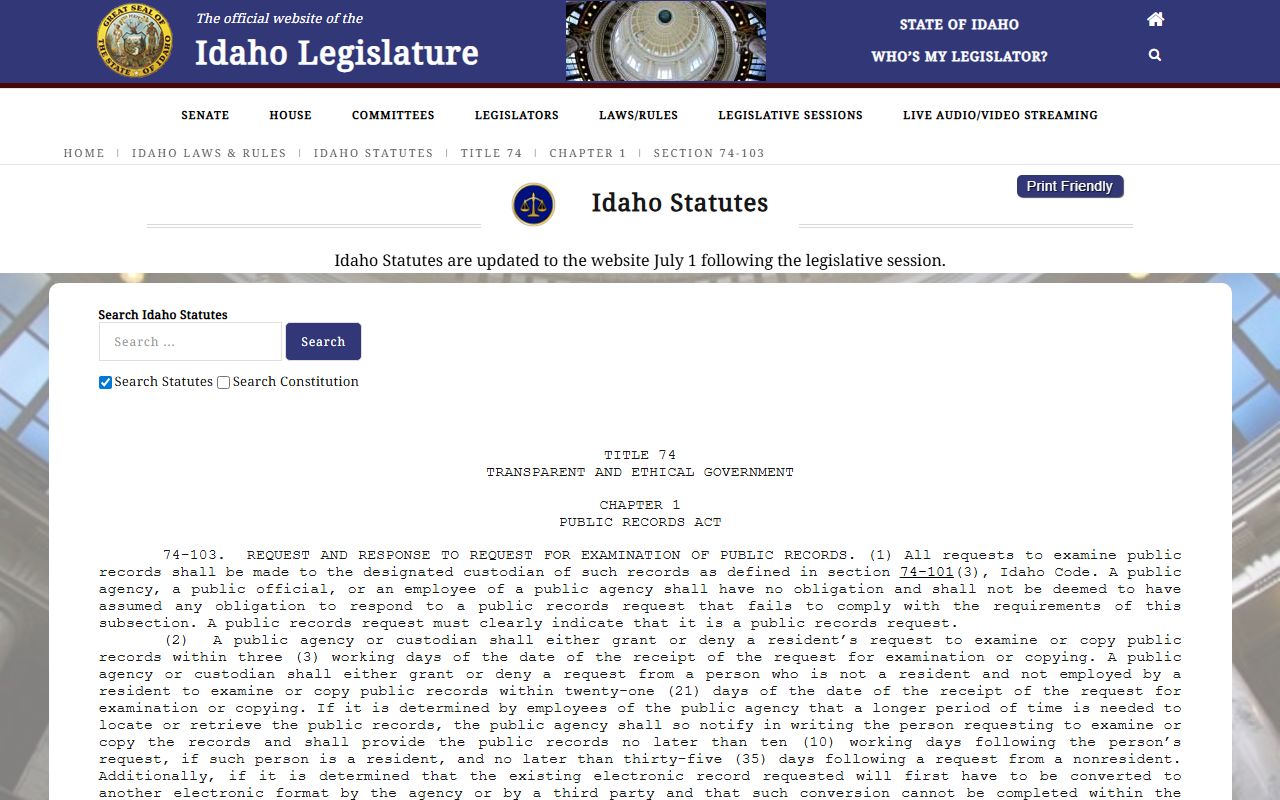
For criminal court records, that request-response framework works beside Idaho court rules, while sheriff investigative records use a separate law-enforcement channel.
Teton County Criminal Case Stages
The criminal court record changes as the case moves. A booking record may exist before the formal court record is complete. The court case develops when the prosecutor files or proceeds on charges and the court records each step. A single docket may show an initial appearance, bond order, plea, motion, hearing, amended charge, dismissal, judgment, sentence, probation condition, payment plan, or restitution entry.
Case flow: Charges Filed › Arraignment › Pretrial and Motions › Plea or Trial › Disposition › Sentencing
| Stage | What Happens |
|---|---|
| Charges filed | A complaint, information, or indictment creates the formal court charge record. |
| Arraignment | The court addresses the charge, plea, counsel status, and next hearing or case deadline. |
| Pretrial and motions | Parties file requests, address evidence issues, change dates, and prepare for plea or trial. |
| Plea or trial | The case resolves by guilty plea, no contest plea where allowed, trial verdict, acquittal, or dismissal. |
| Disposition | The court records the outcome for each charge or count. |
| Sentencing | The court enters jail, prison, probation, fine, restitution, no-contact, or other terms after conviction. |
Teton County Criminal Record Fields
A Teton County criminal court record may show more than the final outcome. It can show the accusation, the court's handling of each count, and whether a charge was dismissed, amended, reduced, or resolved by plea or verdict. It may also show bond, court costs, fines, restitution, probation, no-contact orders, and payment history. Public online access may hide document images or limit details when the case involves juveniles, protected identities, sealed material, or confidential information.
| Field | What It Shows |
|---|---|
| Case Number | The court identifier used for iCourt lookup, courthouse requests, and docket matching. |
| Defendant | The person charged, subject to restrictions for juveniles or protected information. |
| Charges or Counts | Each formal accusation, statute reference, severity level, and charge status when public. |
| Arraignment and Plea | Hearing entry and plea history, such as guilty, not guilty, or no contest where reflected. |
| Motions and Orders | Requests filed by the parties and directives entered by the judge or magistrate. |
| Disposition | The final outcome for each charge, including conviction, dismissal, acquittal, or other resolution. |
| Sentence | Jail, prison, probation, fines, restitution, court costs, no-contact terms, or other ordered conditions. |
| Financial Entries | Bond, fines, payment plans, restitution, court technology fee, and court costs when visible. |
Charges and Convictions Compared
Being charged is not the same as being convicted. A Teton County criminal court record can show counts that were later reduced, dismissed, amended, or resolved in different ways. A conviction appears only after a guilty plea, qualifying no contest plea, or verdict that results in judgment. Reading only the first charge line can give a false picture of the case.
| Issue | Charge | Conviction |
|---|---|---|
| Meaning | A formal accusation filed in court. | A final criminal judgment after plea or verdict. |
| Timing | Appears early in the case and may change. | Appears after disposition and judgment. |
| Record reading | Check count status and amendments. | Check judgment, sentence, and set-aside history. |
| Risk of error | A dismissed charge may still appear in the docket history. | A conviction may later be affected by Idaho set-aside or dismissal relief. |
The image below links to Idaho Code 74-106, which the research cites for personnel and other public-record exemptions.
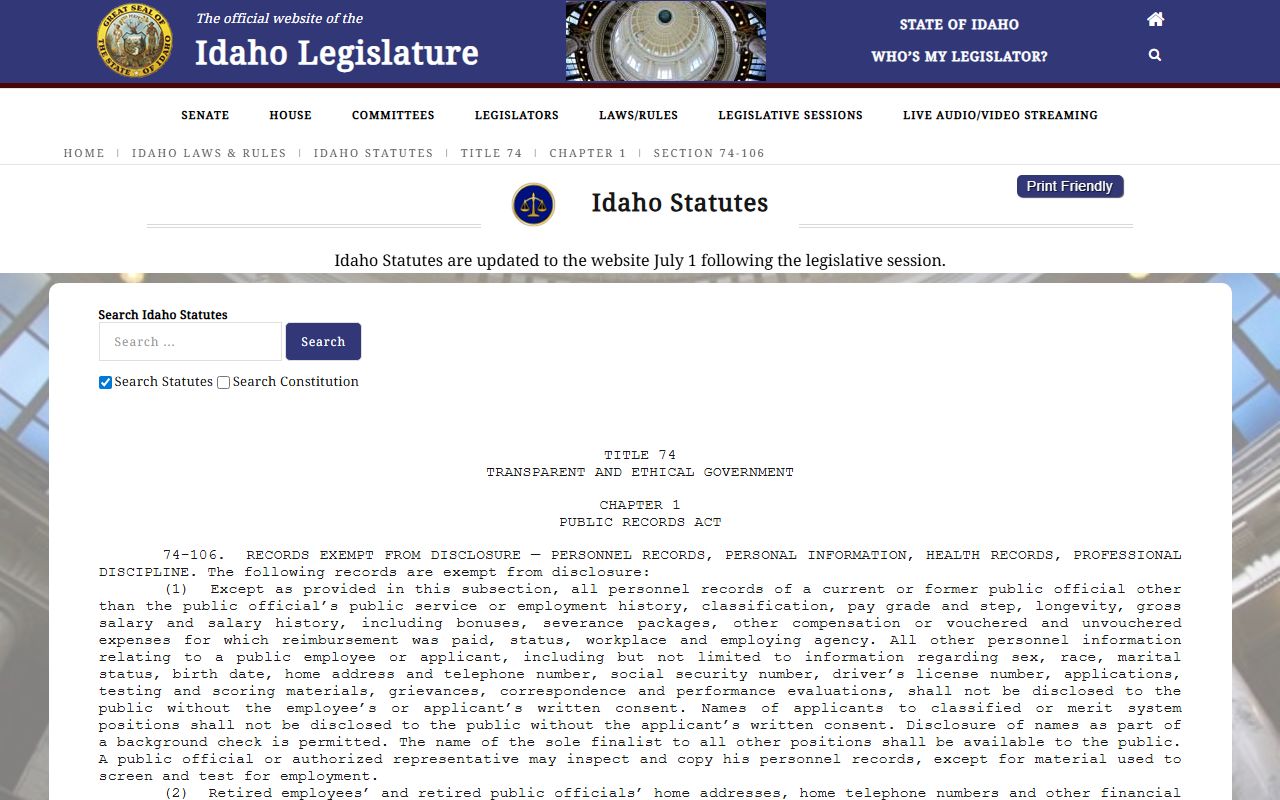
Exemption statutes do not replace court access rules, but they explain why some government records related to a criminal matter may be withheld or redacted.
Disposition and Sentence Reading
The disposition is the outcome. It may show guilty, not guilty, dismissed, dismissed with prejudice, dismissed without prejudice, acquitted, amended, reduced, or another status reflected in the court's case-management system. A sentence follows a conviction and can include jail, prison, probation, fines, court costs, restitution, no-contact orders, or other terms.
Read dispositions count by count. One case can have several charges with different results. A person may be convicted on one count while another count is dismissed. A sentence may also include suspended time, probation terms, payment obligations, or conditions that are not obvious from the short docket line. When legal proof is needed, request the judgment and sentencing order rather than relying on a search-result summary.
Sealed and Set-Aside Records
Sealing, redaction, and Idaho set-aside relief are not the same thing. A sealed record is hidden from public access by law or court order. A redacted record remains public but has protected details removed. Idaho Code 19-2604 provides a dismissal or set-aside route after certain criminal judgments when conditions are met, but the research cautions that it does not promise total deletion from every police, jail, prosecutor, or federal background system.
| Issue | Sealed | Set Aside / Dismissed Under Idaho Law |
|---|---|---|
| Public visibility | All or part of the case is closed from public view. | The public effect of a qualifying judgment may change after court relief. |
| How it happens | By statute or court order. | By motion or petition in the court that entered judgment when eligible. |
| What remains | Some access may remain for courts, agencies, or authorized parties. | Some police, jail, prosecutor, or federal records may still exist. |
| Common limits | Juvenile, adoption, protected, mental health, and sealed criminal material. | Eligibility depends on the exact case, sentence, probation status, and statute. |
The image below links to Idaho Code 19-2604, the set-aside and dismissal statute identified in the research.
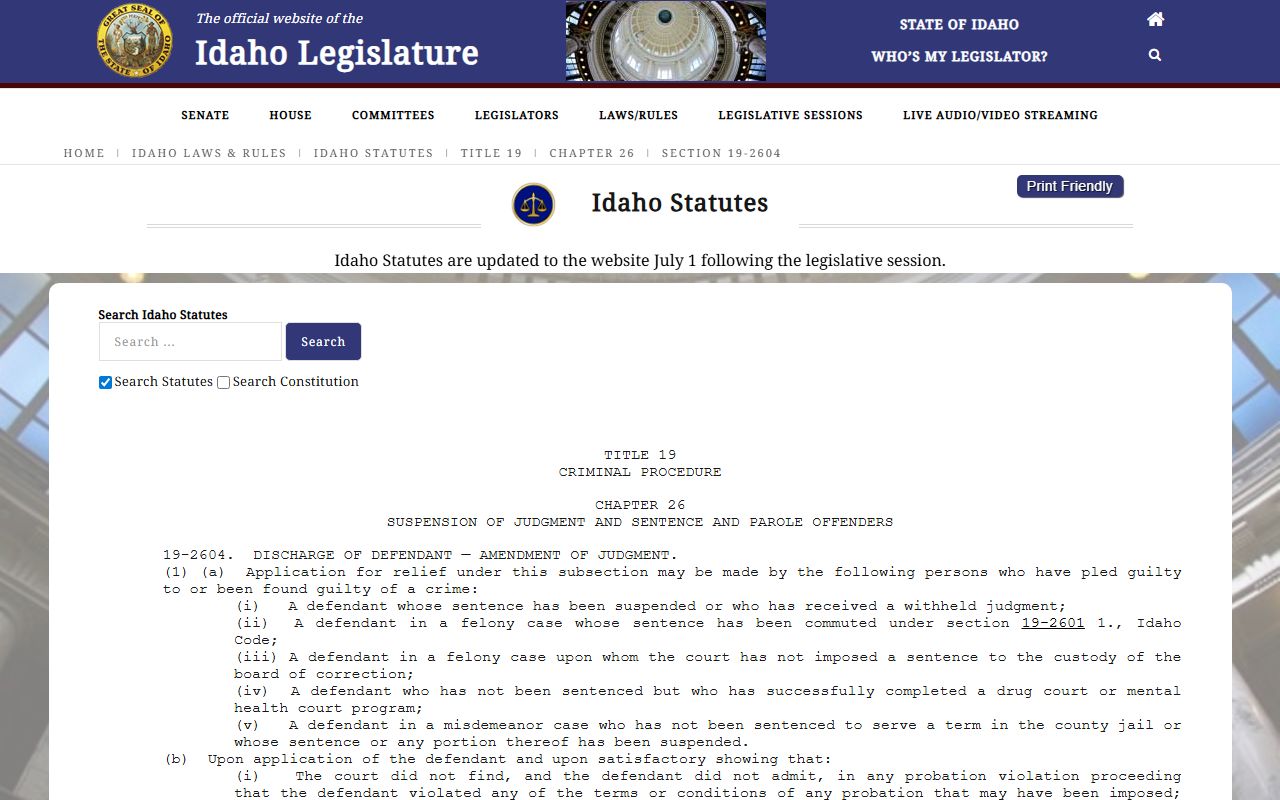
Anyone evaluating a Teton County criminal record should begin with the exact case number and judgment before assuming any record-clearing option applies.
Public Criminal Record Access
Criminal court case files are judicial records, so Idaho Court Administrative Rule 32 is the key access rule for court records. The Idaho Public Records Act also matters for non-court government records, including some county and sheriff records. Idaho Code 74-108 limits disclosure of certain law-enforcement investigatory records, which is why a sheriff report may be treated differently from a public court docket.
The image below links to Idaho Code 74-108, the law-enforcement investigatory-record exemption cited in the research.
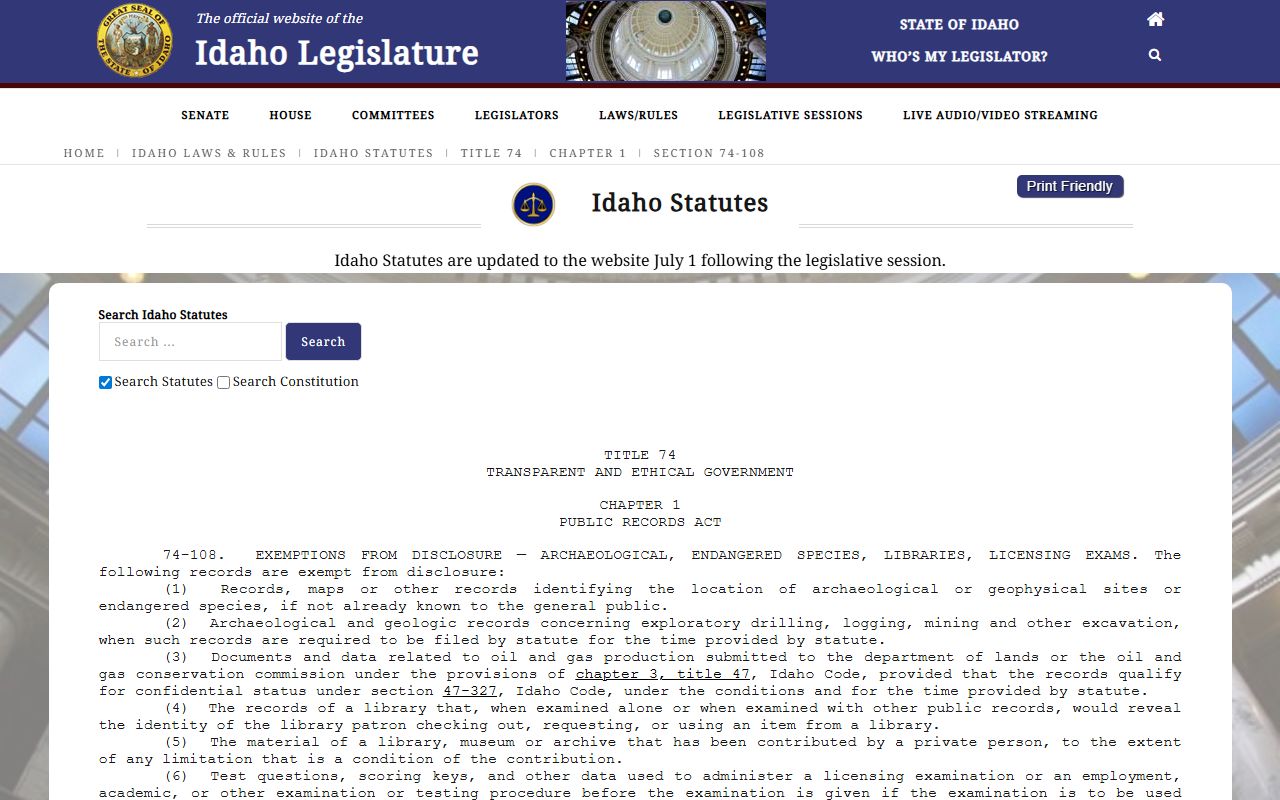
This is the line between the criminal case file and the investigative file: the court record may be public while parts of the police investigation remain restricted.
Restricted Teton County Criminal Records
Juvenile criminal matters are restricted and should not be treated as ordinary public adult criminal records. Idaho Code Title 20, Chapter 5 governs juvenile correction matters, and the research specifically warns against implying that juvenile delinquency, child-protection, or juvenile correction files are freely searchable. Sealed cases, protected identifying information, mental health material, medical details, and confidential family-related information may also be hidden or redacted.
The Teton County Sheriff's Office is a separate access channel for arrest, incident, warrant, and law-enforcement records. Its official public information request page is the right path for sheriff records, while criminal case copies belong with iCourt and courthouse court channels. The sheriff name is not used here because the research marks the current sheriff name as unverified.
Note: A public criminal docket can confirm court activity without revealing protected reports, juvenile files, sealed evidence, or confidential identifiers.
The image below links to Idaho Code Title 20, Chapter 5, the juvenile law source identified in the research.
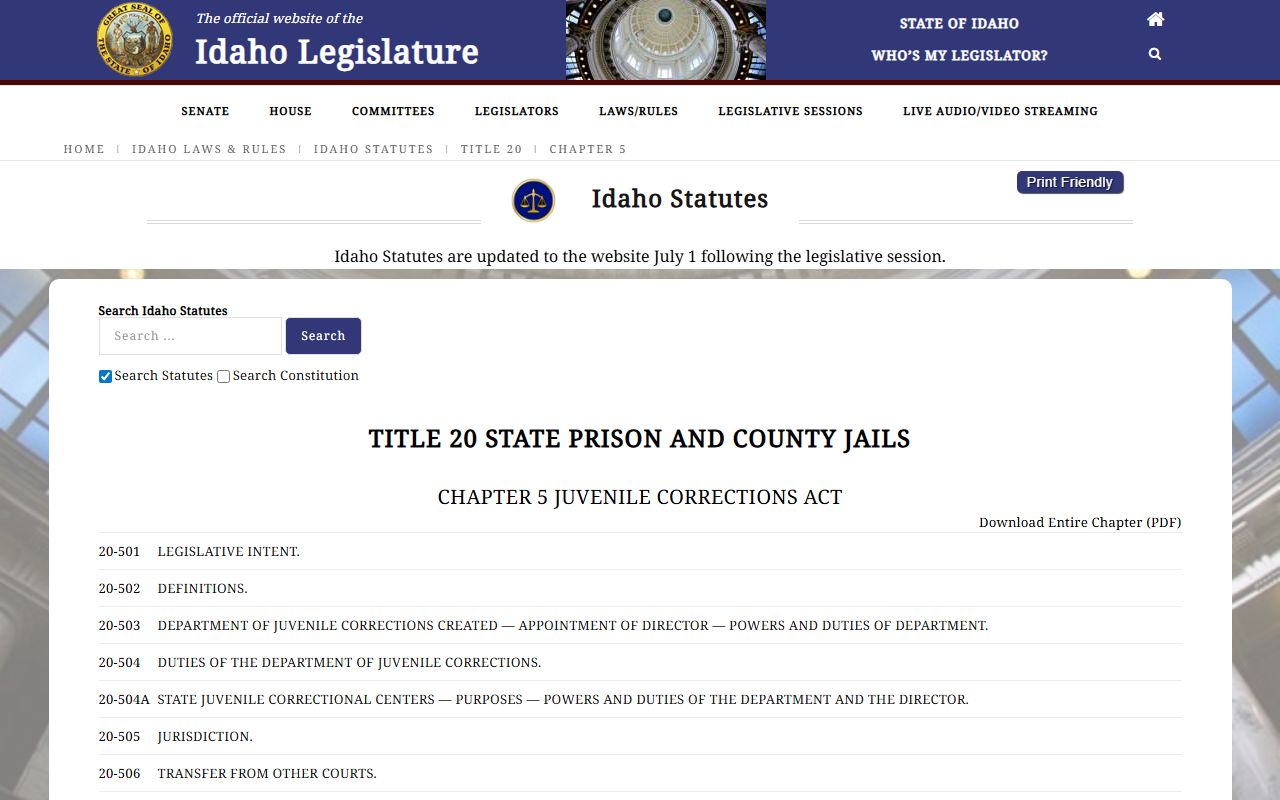
That juvenile distinction is central for Teton County searches because adult criminal case files and juvenile records do not share the same public access rules.