
Teton County Arrest Records and Charges
Teton County arrest records are law-enforcement records tied to an arrest event. They may involve the arresting agency, booking details, incident context, initial alleged offenses, custody routing, and public-information request limits. The sheriff's office is the local law-enforcement records channel, but the research does not verify a public online active arrest database or a sheriff mobile app. It also notes that a Teton County arrest does not guarantee the person is held in a Teton-owned jail, because the Madison County jail roster is the regional custody lookup channel found in the research.
Court charges after arrest are different. Those charges become court records when the prosecutor files or accepts a charging document in the court system. The court charge record may show charge description, statute number, count, severity level, offense date, bond, plea, amendment, dismissal, disposition, sentence, and payments when public. The full case file and final outcome belong in Teton County criminal court records, while the custody side belongs with sheriff and jail channels.
| Record path | Where it starts | What it usually shows |
|---|---|---|
| Arrest record | Law enforcement or booking process | Arrest event, agency, incident report path, initial allegations, custody routing. |
| Jail or roster record | Detention facility or regional jail roster | Current custody, booking status, charges if shown, and release or bond information if public. |
| Court charge record | Prosecutor and court filing | Complaint, information, indictment, counts, statute, plea, status, disposition, sentence. |
Find Teton County Arrest Records
Use the Teton County Sheriff's Office for arrest reports, incident reports, warrant questions, and law-enforcement public information requests. Use Idaho iCourt for charges filed in a court case. These systems answer different questions. A sheriff record can explain the arrest event or investigative record path, while a court record explains what charges were filed and how the judge handled them. The sheriff name is omitted because the research marks the current sheriff name as unverified.
- Start with the Teton County Sheriff's public information request page for arrest, incident, and law-enforcement records.
- Use the sheriff phone line for urgent routing or to confirm whether a public request is the correct channel.
- Check the regional jail roster only for current custody information, not for the full court case outcome.
- Search Idaho iCourt for filed charges, case status, hearings, plea, disposition, sentence, and payment entries.
- Use the courthouse channel for certified copies, older case records, and documents not visible online.
The image below comes from the official sheriff public information request page, the researched path for law-enforcement record requests.
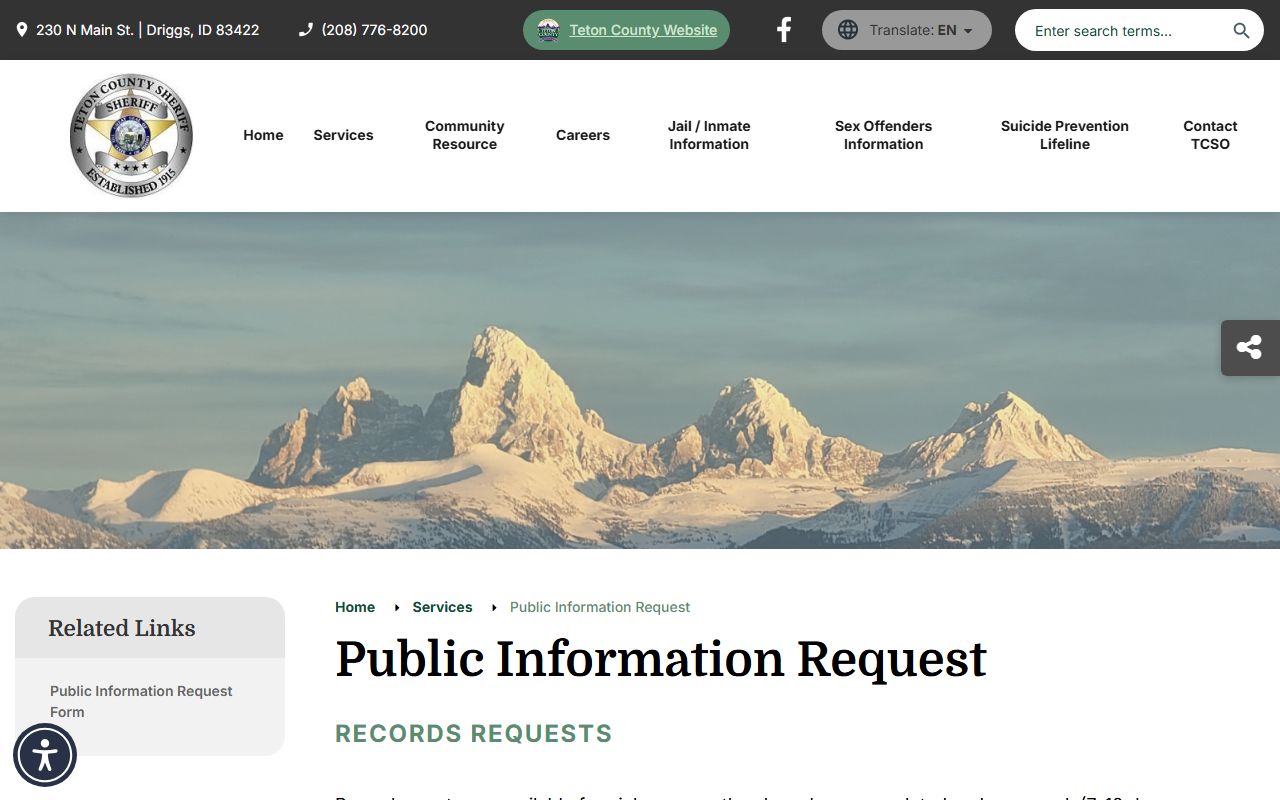
That sheriff request path is separate from Idaho iCourt, which is where court charges after arrest are tracked once a case is filed.
Teton County Charges After Arrest
The prosecutor is the bridge between the arrest event and the court charge record. The official Teton County Prosecuting Attorney page says the office prosecutes felony, misdemeanor, and infraction violations of state and county law occurring within Teton County and brought by state or county law enforcement. It also says the office works with the Teton County Sheriff's Office, Idaho State Police, Idaho Fish and Game, and other agencies to build cases and prosecute offenders. That supports the core distinction: arresting-agency allegations do not become court charge records until they are filed or accepted in court.
| Charging document | Who files or produces it | Typical role in the case |
|---|---|---|
| Complaint | Officer or prosecutor, depending on charge and process | Common starting document for criminal charges and probable-cause allegations. |
| Information | Prosecutor | Formal prosecutor-filed charging document, often used after preliminary felony steps. |
| Indictment | Grand jury process | Formal felony accusation through grand jury procedure when used. |
The image below links to the Teton County Prosecuting Attorney page, the local source for prosecutor duties.

The prosecutor's described duties are why a court charge record can differ from the initial arrest or booking allegation.
Teton County Charge Status Terms
Charges can change as the court case moves. A charge may be pending at arraignment, amended during plea talks, reduced to a different count, dismissed, or resolved by plea or trial. One arrest can produce several counts, and each count can have its own outcome. That is why a reader should check the current charge status, not just the first booking phrase or the first court entry.
| Status | What It Means |
|---|---|
| Pending | The charge is active and has not yet reached final disposition. |
| Amended | The prosecutor or court record changed the charge, count, or legal description. |
| Reduced | The charge was changed to a lower level or different offense as reflected in the case. |
| Dismissed with prejudice | The charge was dismissed and generally cannot be refiled in the same way. |
| Dismissed without prejudice | The charge was dismissed, but refiling may be possible if allowed by law. |
| Disposed | The court entered a final outcome for that charge or case. |
Charges vs Convictions
A charge is an accusation filed in court. A conviction is the final result after a guilty plea, qualifying no contest plea, or verdict that produces judgment. Teton County court charge records may show charges that never became convictions. They may also show counts that were dismissed, amended, reduced, or resolved differently from other counts in the same case.
| Issue | Charge | Conviction |
|---|---|---|
| Stage | Formal accusation after arrest or investigation. | Final judgment after plea or verdict. |
| Where to read it | Charging document and early docket entries. | Disposition, judgment, and sentence entries. |
| Can it change | Yes, it may be amended, reduced, added, or dismissed. | It can be affected by appeal or qualifying Idaho post-judgment relief. |
| Search risk | Initial arrest wording may be broader than the final filed case. | A short search result may omit sentencing detail or later set-aside history. |
Sealed and Set-Aside Charge Records
Some arrest and charge information is restricted. Juvenile matters are not ordinary adult public records. Sealed records may show limited metadata or no public result. Idaho does not offer a single broad adult expungement path for every conviction, but Idaho Code 19-2604 allows a set-aside or dismissal route for certain qualifying criminal judgments. That relief should not be described as total deletion of every sheriff, jail, prosecutor, court, or federal record.
| Issue | Sealed | Set Aside / Dismissed |
|---|---|---|
| Access effect | Public access to all or part of the case is restricted. | The legal effect of a qualifying conviction may change after court relief. |
| Applies to | Records closed by law or court order, including protected categories. | Only cases that meet Idaho statutory and court requirements. |
| Remaining records | Courts or agencies may retain authorized access. | Arrest, jail, prosecutor, law-enforcement, or federal records may still exist. |
Teton County Charge Codes
A charge record should be read by count. Each count can name a statute, offense description, severity level, offense date, and status. The research identifies felony, misdemeanor, infraction, juvenile, and criminal traffic paths in the Idaho court structure. Misdemeanors and many traffic matters are handled in the Magistrate Division. Felony cases may begin in magistrate proceedings and move to District Court after bindover or formal filing.
Charge codes are not the same as driver records, jail records, or sheriff reports. A DUI or driving-without-privileges matter is criminal traffic and should be read as a criminal court case. A simple traffic infraction may still appear in iCourt and payment channels, but the driver-history consequences belong to Idaho Transportation Department records. For arrest and court charge searches, keep the law-enforcement record, court record, and driver record separate.
The image below links to the Idaho State Police sex offender registry, a statewide registry source separate from court charge records.
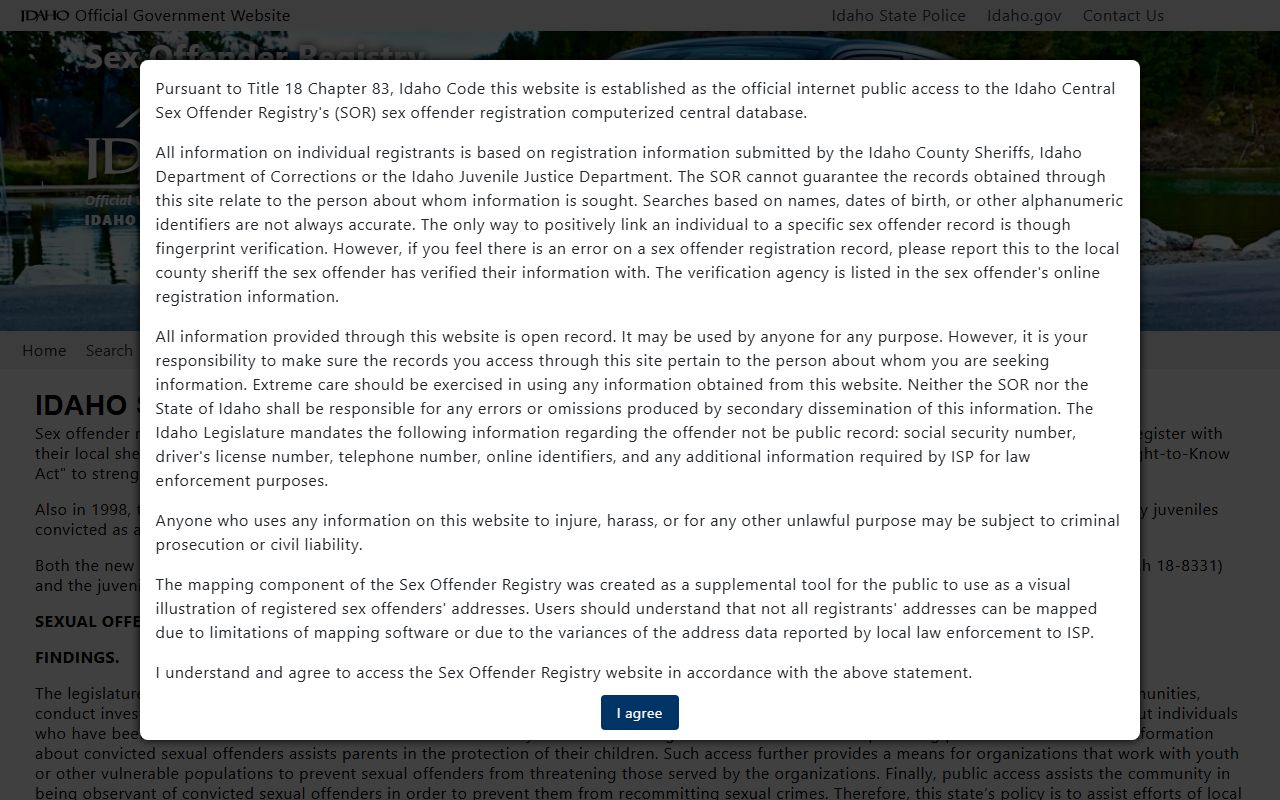
The registry is a state law-enforcement resource, not the Teton County court charge file, so it should not be used as a substitute for iCourt case review.
State and Federal Charge Channels
Not every charge connected to a Teton County person or event is held by Teton County. State prison and supervision records belong with the Idaho Department of Correction. Sex offender registration is a separate Idaho State Police registry resource. Federal criminal matters are handled by federal courts and federal agencies, not the Teton County courthouse or Idaho iCourt. The research lists the U.S. District Court for the District of Idaho, PACER, District of Idaho CM/ECF, the Ninth Circuit, the U.S. Attorney's Office, U.S. Marshals, and the Bureau of Prisons as federal channels.
The image below links to the U.S. Attorney's Office for the District of Idaho, the federal prosecutor source for District of Idaho cases.
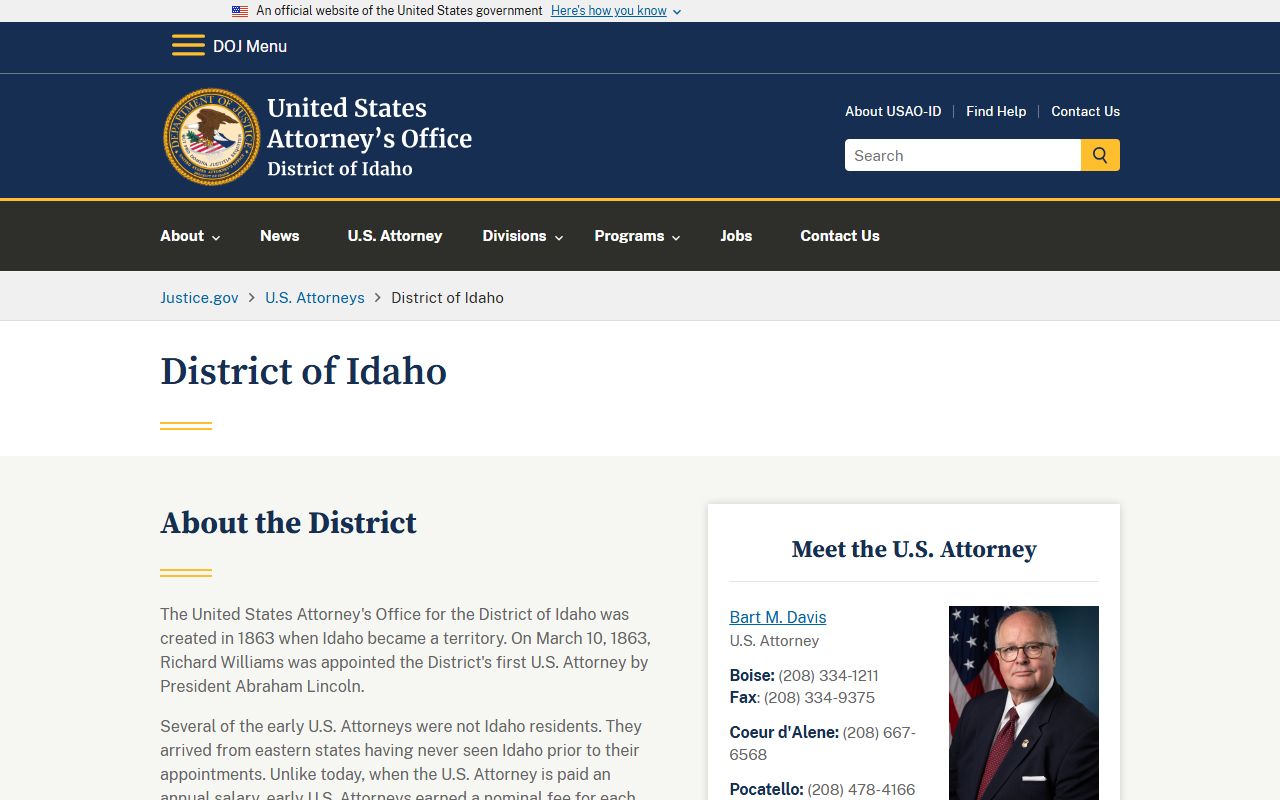
Use federal sources only for federal cases. Teton County arrest records and Idaho state court charges remain separate from federal prosecution records.
Restricted Teton County Charge Records
Access limits depend on record source. A court charge can be public while an investigative sheriff report is withheld under law-enforcement exemptions. A booking allegation can be visible while the prosecutor later files a different charge. Juvenile charges, sealed records, mental health details, protected addresses, minor identities, medical information, Social Security numbers, financial accounts, and some family-related information can be redacted or closed.
Idaho Code 74-108 limits certain law-enforcement investigatory records. Idaho Court Administrative Rule 32 governs judicial records. Idaho Code 74-102 and 74-103 address public records more broadly, while Idaho Code 9-338 governs public-record copy fees and is cited by the county fee schedule. Those rules should be applied to the correct record holder. Sheriff records go through the sheriff request channel. Court charges and dispositions go through iCourt and courthouse channels.
Note: No official Teton County online active arrest database, active warrant list, or sheriff mobile app was verified in official sources.